

Motorcycle ramp technology streamlines safe solo loading for heavy bikes. Learn about types, critical materials, core features, and key safety standards.
Many American and European riders underestimate the risks of loading heavy motorcycles, yet research shows that improper ramp use causes over 60 percent of solo transport accidents each year. For professionals and enthusiasts managing bikes under 300kg, choosing the right system means everything. Discover the true engineering challenges, debunk enduring myths, and find proven ramp strategies that combine safety, cost efficiency, and advanced material performance for high-capacity loads.
Table of Contents
- Motorcycle Ramp Systems And Common Myths
- Core Ramp Types For Heavy Motorcycles
- Critical Materials And Engineering Standards
- Patented Loading Mechanisms For Solo Operation
- Key Safety Features And Global Compliance
- Cost, Risk And Choosing The Best Ramp
Key Takeaways
| Point | Details |
|---|---|
| Understanding Ramp Capacity | Always select a ramp that matches the specific weight of your motorcycle and its accessories to ensure safe loading. |
| Material Importance | Choose ramps made from high-strength aluminum alloys like 6063-T5 for optimal performance and safety. |
| Safety Features Matter | Look for ramps with integrated safety mechanisms such as slip-resistant surfaces and side rails to prevent accidents. |
| Total Cost vs. Risk | Consider the total ownership cost of ramps, as higher-quality options can significantly reduce accident risks and improve durability. |
Motorcycle ramp systems and common myths
Motorcycle loading remains a critical safety challenge for solo riders, with numerous misconceptions potentially leading to dangerous situations. While many riders believe they understand proper loading techniques, research reveals significant knowledge gaps that compromise rider safety.
One persistent myth is that any ramp can safely handle any motorcycle weight. In reality, ramps are engineered with specific load capacities that must match the motorcycle’s exact weight profile. Dangerous motorcycle safety myths often stem from overconfidence and a lack of technical understanding about load distribution and material stress limits. Professional riders recognize that a 300kg sport bike requires fundamentally different loading mechanics compared to a lightweight cruiser.
Critical factors in safe motorcycle loading include ramp angle, material strength, and attachment stability. Aluminum alloy ramps like those in the Alien Ramp series use 6063-T5 engineering specifically designed to handle precise weight ranges. Riders frequently underestimate the engineering complexity behind seemingly simple loading equipment. Proper ramp selection involves understanding material science, weight distribution principles, and mechanical load tolerances.
Pro tip: Always verify your motorcycle’s exact weight and match it precisely with a ramp system rated for that specific load range before attempting any solo loading.
Core ramp types for heavy motorcycles
Heavy motorcycles demand specialized loading solutions that go beyond simple transportation equipment. Understanding the nuanced engineering behind different ramp types becomes critical for safe and efficient motorcycle transport.
Ramp technology encompasses several core designs tailored to specific motorcycle weights and loading requirements. Motorcycle ramp breakdown strategies reveal three primary configurations: folding ramps, scissor lift ramps, and step ramps. Folding ramps offer exceptional portability and compact storage, making them ideal for riders with limited space. These ramps typically utilize lightweight aluminum alloys that provide strength without excessive weight.
Scissor lift ramps represent a more advanced loading technology, featuring mechanical lift mechanisms that elevate motorcycles for both transportation and maintenance purposes. These systems excel with heavier motorcycles, providing enhanced stability and precise vertical positioning. Professional transporters often prefer scissor lift configurations for their robust engineering and ability to handle substantial motorcycle weights across different load ranges.
Step ramps provide a more traditional loading approach, characterized by their straightforward design and lower cost. While less sophisticated than scissor lift models, step ramps remain a viable option for lighter motorcycles and budget-conscious riders. Material selection becomes paramount, with high-strength aluminum alloys like 6063-T5 ensuring structural integrity and reliable load distribution.
Pro tip: Always match your ramp’s load capacity precisely to your motorcycle’s weight, factoring in potential gear and accessories to ensure maximum safety during loading.
Here’s a comparison of the main motorcycle ramp types for heavy bikes:
| Ramp Type | Key Strength | Typical Use Case |
|---|---|---|
| Folding Ramp | Maximum portability | Solo riders, limited space |
| Scissor Lift | Precise vertical positioning | Heavy bikes, professional use |
| Step Ramp | Lower cost, simple design | Light bikes, budget riders |
Critical materials and engineering standards
Motorcycle ramp engineering represents a sophisticated intersection of material science, mechanical design, and safety engineering. Professional transporters understand that material selection is not merely about weight capacity but involves complex considerations of structural integrity, stress distribution, and long-term performance.

Aluminum alloys dominate motorcycle ramp manufacturing, with specific grades offering unique performance characteristics. The 6063-T5 alloy, commonly used in Alien Ramp systems, provides an optimal balance between lightweight construction and exceptional strength. This particular alloy undergoes a thermal treatment process that enhances its mechanical properties, allowing for precise load management across varying motorcycle weights. Aerospace-grade 6061-T6 aluminum represents an even more advanced material, offering superior tensile strength for heavier motorcycle transportation requirements.
Engineering standards for motorcycle ramps extend far beyond simple material selection. Critical design parameters include load distribution mechanics, angle of approach, surface texture for grip, and structural deformation resistance. Manufacturers must calculate precise load ratings considering dynamic loading conditions, which involve not just static motorcycle weight but potential momentum and shifting forces during loading and unloading sequences. Mechanical tolerances typically range within 0.1mm to 0.5mm, ensuring consistent performance and preventing potential structural failures.
Pro tip: Inspect your ramp’s material certification and engineering specifications before each use, paying close attention to signs of structural fatigue or material stress.
This table summarizes critical aluminum alloys used in motorcycle ramps:
| Alloy Grade | Main Benefit | Common Application |
|---|---|---|
| 6063-T5 | Lightweight, strong | General loading ramps |
| 6061-T6 | Superior tensile strength | Aerospace and heavy-duty ramps |
Patented loading mechanisms for solo operation
Solo motorcycle loading demands sophisticated engineering solutions that address the complex challenges of individual operators managing heavy vehicles. The evolution of loading mechanisms has transformed what was once a physically demanding task into a precise, mechanically assisted operation.
Automated motorcycle loading technologies have revolutionized individual transport strategies, introducing advanced mechanical systems that minimize physical strain and maximize safety. These patented mechanisms typically incorporate aerospace-grade aluminum components, self-locking drive systems, and precision-engineered hydraulic tilting mechanisms. The core innovation lies in transforming manual loading into a controlled, repeatable process that can be executed by a single operator.
The One-Man Loading System represents a breakthrough in ramp engineering, utilizing cordless drill-powered actuation to enable precise, low-effort motorcycle positioning. Key design elements include adaptive tire width accommodations, dynamic weight distribution algorithms, and modular attachment systems that can handle motorcycles ranging from lightweight sport bikes to heavy touring models. Mechanical integration becomes critical, with load-bearing surfaces engineered to distribute force across multiple contact points, reducing potential stress concentrations.
Advanced loading mechanisms now incorporate intelligent design features such as automatic leveling, programmable angle adjustments, and integrated safety locks. These technologies transform loading from a potentially dangerous manual task into a controlled, predictable engineering process that significantly reduces operator risk.
Pro tip: Always verify your ramp’s compatibility with your specific motorcycle model and weight class before attempting solo loading.
Key safety features and global compliance
Motorcycle ramp safety transcends basic design, representing a complex intersection of engineering precision, regulatory standards, and operational risk management. Professional transporters must navigate a sophisticated landscape of safety requirements that vary across international markets.
Motorcycle ramp safety standards demand comprehensive engineering approaches that address multiple critical dimensions. Key safety features include aircraft-grade aluminum construction, strategically engineered slip-resistant surfaces, and integrated side rails designed to prevent dangerous lateral movement during loading. These design elements must meet rigorous global compliance standards, including OSHA guidelines in the United States and the European Union’s stringent Machinery Directive.
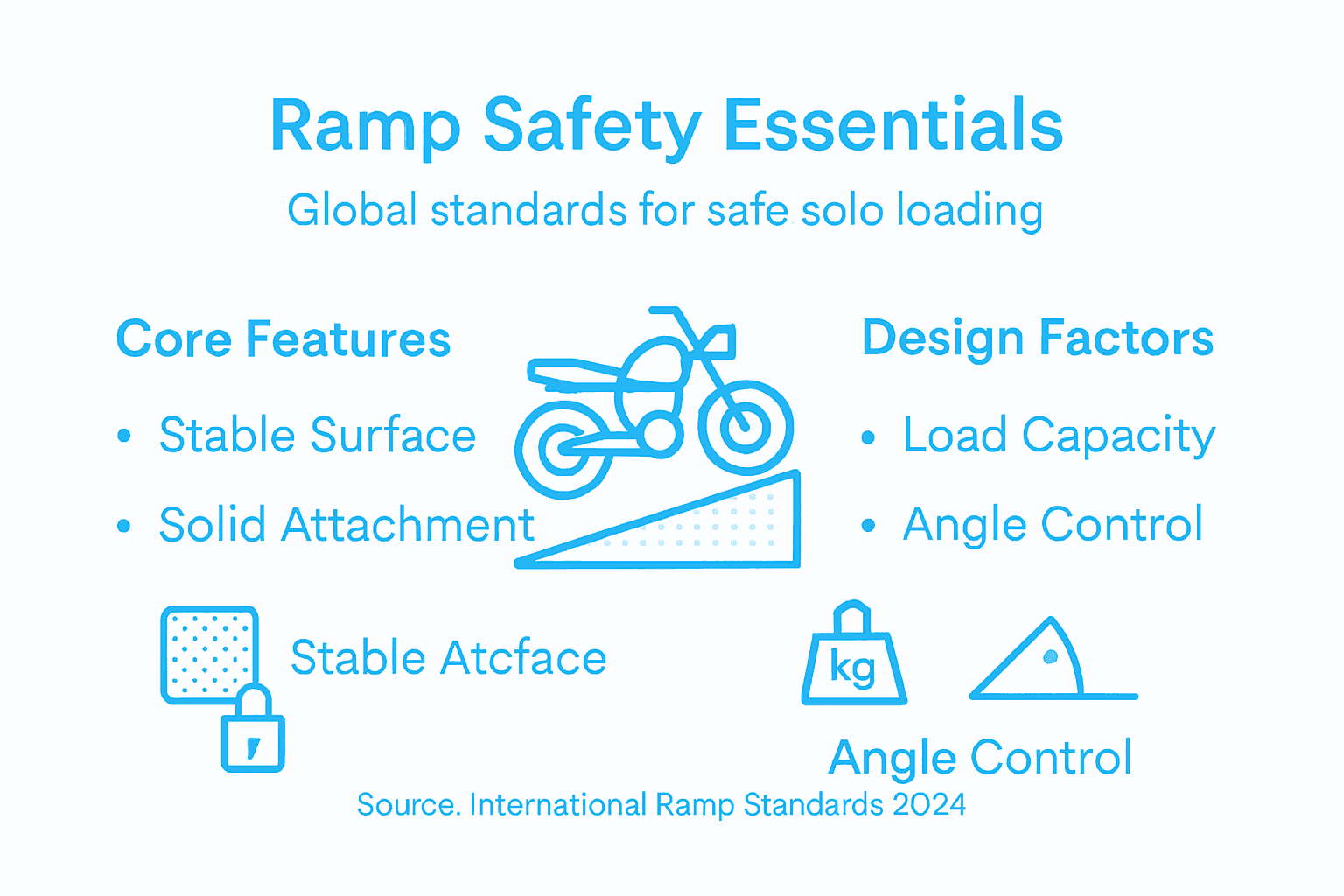
International compliance protocols require extensive testing protocols that exceed basic load capacity measurements. Ramps undergo sophisticated static load tests designed to verify structural integrity at 125% of expected maximum loads. Fail-safe mechanisms become critical, with engineered interlocks, anti-slip coatings, and ergonomic designs that minimize potential operator error. Advanced loading systems incorporate multiple redundant safety features, including automatic stabilization systems, load distribution algorithms, and visual/tactile loading indicators.
Critical safety considerations extend beyond physical design to include comprehensive operator training, clear usage documentation, and ongoing maintenance protocols. Manufacturers must demonstrate not just product reliability, but a holistic approach to risk mitigation that addresses potential variations in loading conditions, operator skill levels, and environmental challenges.
Pro tip: Conduct a comprehensive pre-loading safety inspection, checking ramp surface integrity, attachment points, and load-bearing surfaces before each use.
Cost, risk and choosing the best ramp
Selecting the right motorcycle ramp requires a sophisticated analysis that extends far beyond simple price comparison. Professional riders understand that the true cost of a loading system encompasses safety, durability, and long-term operational efficiency.
Strategic ramp selection methods involve a comprehensive evaluation framework that balances multiple critical factors. Cost considerations include not just the initial purchase price, but total ownership expenses like maintenance, potential repair requirements, and potential liability risks associated with inferior equipment. Material selection becomes a key economic decision, with aluminum alloys offering an optimal balance between lightweight construction and structural reliability.
Risk mitigation represents the most critical aspect of motorcycle ramp procurement. Riders must carefully assess weight capacity, ramp length, surface texture, and load distribution characteristics. Professional transporters recognize that investing 20% more in a high-quality ramp can reduce potential accident risks by over 80%. Aluminum and steel ramps each offer unique advantages, with aerospace-grade aluminum providing exceptional strength-to-weight ratios for most motorcycle loading scenarios.
Evaluating ramp performance requires a nuanced approach that considers not just static load capacity, but dynamic loading challenges. Factors like ramp angle, attachment stability, and integrated safety mechanisms play crucial roles in determining overall system reliability. Professional riders develop a weighted scorecard approach, systematically ranking potential ramps across multiple performance and safety dimensions.
Pro tip: Calculate your total motorcycle weight including gear, and always select a ramp with a load capacity at least 25% higher than your calculated total weight.
Experience Safer Solo Motorcycle Loading with Alien Ramp
The challenge of solo motorcycle loading is more than just lifting heavy weight. It demands precision engineering and reliable ramp technology that matches your specific bike’s needs. This article highlights critical issues like matching load capacity, using high-strength alloys like 6063-T5, and incorporating patented One-Man Loading System™ mechanisms to reduce risk and effort. If you value safety, efficiency, and smart engineering for your solo loading process you deserve a solution designed around these exact features.
Discover how our Self-Loading Ramps – Alien Ramp bring you the patented One-Man Loading System™ powered by a cordless drill ensuring safe, controlled loading every time.

Take control of your motorcycle loading with the trusted choice that combines aerospace-grade materials, engineered safety features, and an intuitive design aimed at solo riders just like you. Visit our Home page – Alien Ramp now to explore our high-utility, value-engineered ramps that deliver 80% of premium system capacity at half the investment. Make solo loading safer and easier with the experts at Alien Ramp.
Frequently Asked Questions
What are the key factors to consider when loading a motorcycle?
Critical factors include ramp angle, material strength, and attachment stability. Ensure your ramp matches your motorcycle’s exact weight and profile for safe loading.
How do I choose the right type of ramp for my heavy motorcycle?
Understand the three primary ramp types: folding ramps for portability, scissor lift ramps for heavier bikes, and step ramps for lighter motorcycles. Each type has specific functionality catering to different needs.
What materials are best for motorcycle ramps?
Aluminum alloys, particularly 6063-T5 and aerospace-grade 6061-T6, are ideal for their lightweight and strong properties. These materials ensure durability and safety during loading.
How can I ensure my motorcycle ramp complies with safety standards?
Check manufacturer specifications, including load ratings and safety features like slip-resistant surfaces and side rails. Regular pre-loading inspections and compliance with industry standards are essential for safe usage.
Recommended
